Engine Cranks But Does Not Run for Chevrolet Captiva 2008
Diagnostic Instructions
Circuit/System Description
The Engine Cranks but Does Not Run diagnostic table is an organized approach to identifying a condition that causes an engine not to start. This diagnostic directs the service technician to the appropriate system diagnosis.
Diagnostic Aids
Inspect for any of the following conditions:
| • | Insufficient fuel can cause a no start condition. Thoroughly inspect the fuel delivery system for sufficient fuel volume to the fuel injectors. Inspect the fuel supply components for partial blockage or restrictions. |
| • | There may be fuel spray at the fuel injectors and the indicated fuel pressure may be correct, yet there may not be enough fuel to start the engine. If the fuel injectors and the injector circuit are OK, and fuel spray is detected, the fuel injector
ON time may be inadequate. If the engine control module (ECM) receives incorrect inputs from the various information sensors, the fuel delivered by the fuel injectors may be inadequate to start the engine. Check all the engine data parameters with a scan tool
and compare the values indicated with the expected values or the values from a known good vehicle. |
| • | Check the crankshaft position (CKP) sensor engine reference signal with a scan tool. Observe the Engine Speed parameter while cranking the engine. The scan tool should indicate a steady 200-300 RPM while cranking. If erratic values,
such as sudden spikes in the engine speed are displayed, the engine reference signal is not stable enough for the engine to start and run properly. |
| • | Inspect the engine for good secure electrical grounds. |
| • | Water or foreign material in the fuel can cause a no start or engine will not stay running condition. During freezing weather water can freeze inside the fuel system. The engine may start after 30 minutes in a heated repair shop. The malfunction
may not recur until parked overnight in freezing temperatures. Extreme weather conditions can cause contaminated fuel to prevent the vehicle from starting. |
Reference Information
Schematic Reference
Engine Controls Schematics
Electrical Information Reference
Scan Tool Reference
Control Module References
Special Tools
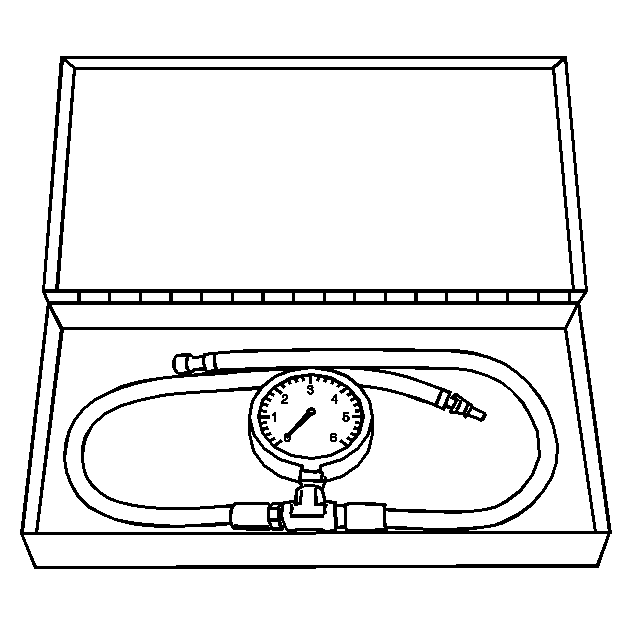
DW100-010
Fuel Pressure Gage
Circuit/System Verification
Important: This diagnostic assumes the following:
| • | The engine cranking speed should be at least 100 RPM cold and 180 RPM hot. Refer to
Engine Cranks Slowly. |
| • | There is adequate fuel in the fuel tank. |
- Engine cranking for 15 seconds, observe the DTC information with a scan tool. Verify that DTC P0090, P0091, P0092, P0190, P0191, P0192, P0193, P0335, P0336, P0602, P0606, P0607, P060A, P060B, P061C, P062B, P062F, P068A, P068B, P161E, P0627,
P064C, P0670, P0671, P0672, P0673, P0674, P2146, P2149, P2293, P2294, P2295, P2296, P2510, P2636, P268A, or P2687 is not set.
- Ignition ON, observe the scan tool Theft Deterrent parameter. The reading should display Disabled.
- Visually inspect the fuel system from the high pressure pump to the fuel tank for leaks.
- Ignition ON, command the fuel pump ON with a scan tool. You should hear the fuel pump turn ON.
- Ignition OFF, install the
DW100-010
to the fuel supply pipe at the fuel filter assembly. Refer to
Fuel Pressure Gage Installation and Removal.
Important:
| • | The fuel pump may need to be commanded ON a few times, in order to obtain the highest possible fuel pressure. |
| • | Do NOT start the engine for this test. |
- Ignition ON, command the fuel pump ON with a scan tool. The fuel pressure should be between 415-535 kPa (60-78 psi).
- Verify the following conditions do not exist:
| • | Collapsed air intake duct to the throttle body |
| • | Restricted air filter element |
| ⇒ | If you find any of the above conditions, repair as necessary. |
Repair Instructions
Perform the
Diagnostic Repair Verification after completing the diagnostic procedure.